
"Before you deposit your first rupee, understand that a big bonus is not what beats the dealer. Knowing the math behind a simple table game protects your bankroll better than any promotional offer." - Nisha Rao, Casino and Betting India.
Playing a blackjack game well requires practical knowledge. The online space is packed with different versions, unclear odds, and side bets that carry real risks. Your job? Understand the blackjack rules, verify the platform's safety, and pick an option that fits your limits. This guide explains how to play blackjack online, how to handle your hand, and what to check for trust and payout speed before making any financial commitment.
This content is for informational purposes only and does not constitute financial or legal advice. Gambling laws vary by Indian state. Always play responsibly and within your means.
Blackjack is a card game where your hand competes against the dealer's hand, not other players. Your goal is to get closer to 21 than the dealer without going over.
This guide covers the full rules, step-by-step instructions for online play, the difference between live and RNG formats, a basic strategy cheat sheet, card-counting basics, bonus-wagering traps, KYC tips for Indian players, and an expanded FAQ. Essentially, everything a new or intermediate player needs before placing a real-money bet.
What Blackjack Is and How the Game Works
Blackjack is a comparative card game where your hand attempts to beat the dealer without exceeding a point total of 21. You do not compete against other players at the table. Your only focus is the dealer's card and your own hand. Simple enough on paper, but the decisions within each round are where things get interesting.
The Goal of Reaching 21 Without Going Bust
The goal is straightforward: your final hand total needs to be higher than the dealer's total, and neither of you can exceed 21. If your hand goes over 21, you go bust and lose the bet automatically. A bust is an immediate loss, regardless of what the dealer draws next.
"The risk of busting rises sharply as the hand total increases; totals of 11 or less cannot bust with a single additional card." - Georgia Institute of Technology, Probability Analysis of Blackjack.
With a hand of 12, the bust probability is roughly 31%. At 14 it climbs to about 46%. At 16 it exceeds 60%. So the real aim is not simply chasing 21. Often, the smarter play is letting the dealer bust while you hold a stable hand. Your win relies on risk management more than luck.
How a Blackjack Hand Starts With the First Two Cards
A blackjack hand starts when the first two cards are dealt face up to the player, while the dealer receives one card face up and one face down. Your fast read of these two cards dictates your next move. If your first two cards deal an Ace and a 10-value card, you have a natural blackjack. This combination usually pays out at 3:2 odds.
When cards are dealt, you must evaluate their combined value right away. Are you sitting on a strong 20? A tricky soft 16? Your starting two cards determine whether your hand is weak, average, or strong, and that assessment shapes every decision that follows.
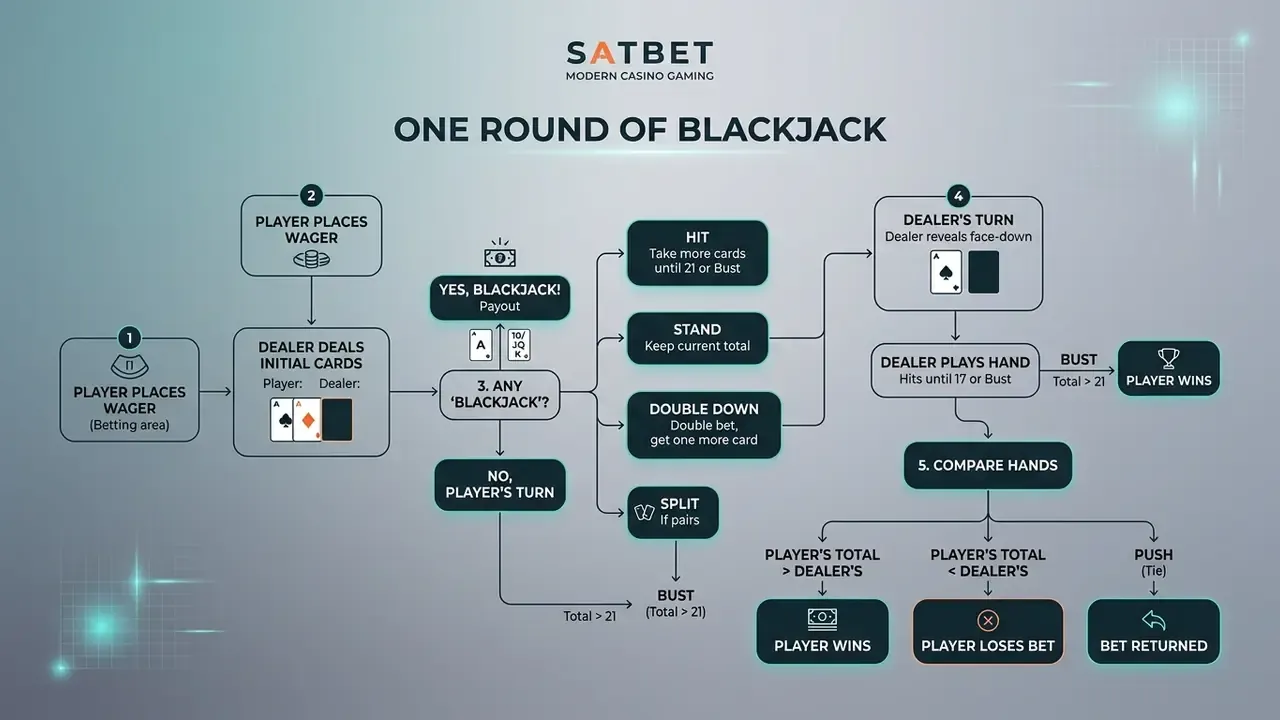
- Place your bet.
- First two cards are dealt to the player and the dealer.
- Player makes a decision (Hit, Stand, Double, Split).
- Dealer plays their hand based on table rules.
- Result is calculated (Win, Lose, Push).

A Brief History of the Name "Blackjack"
The game descends from the French card game Vingt-et-Un ("Twenty-One"), popular in European casinos since the 18th century. According to French card historian Thierry Depaulis, the English name "blackjack" likely arose during the Klondike Gold Rush. Prospectors used the mining term black-jack (zinc blende, a mineral linked to silver and gold deposits) to describe the bonus paid for hitting 21 from just two cards. The association between a black Ace-and-Jack combination and the name came later as a folk etymology. A small detail, but it says something about how gambling language evolves through culture rather than logic.
Blackjack Rules Every Player Should Know
Blackjack rules govern exactly how card totals are calculated and what actions you are permitted to take during a standard game. These rules maintain the house edge and determine your possible payout. Below are the key rules every player must internalise:
- Your aim is to beat the dealer by reaching a score as close to 21 as possible without going over.
- If your score exceeds 21, you bust and lose, regardless of the dealer's hand.
- If your score ties with the dealer, it is a push, and your bet is returned.
- You place your bet before any cards are dealt.
- The dealer has one face-up and one face-down card (the "hole card").
- An Ace counts as 1 or 11, whichever benefits you most.
- Ten, Jack, Queen, and King each count as 10.
- Cards 2 through 9 count at face value.
- You may "hit" to receive another card, or "stand" to keep your total.
- You may "split" pairs into two separate hands.
- You may "double down," doubling your bet for exactly one more card.
- The dealer must hit on 16 or less and stand on 17 or more.
- Insurance is offered when the dealer shows an Ace (not recommended, see below).
Card Values and When a Hand Is Strong or Weak
Card values are fixed: cards 2 through 9 retain their face value, face cards count as 10, and an Ace is valued at 1 or 11 depending on what benefits the hand.
"Initial hands with totals of at least 18 are generally favorable, particularly when the dealer's up-card is between 2 and 6." - Georgia Institute of Technology, Probability Analysis of Blackjack.
A hand is weak if the total sits between 12 and 16. These totals are vulnerable, often called "stiff" hands. A "soft" hand contains an Ace counted as 11 (for example, Ace + 6 = soft 17), which gives you flexibility because you cannot bust by taking one more card. A "hard" hand lacks an Ace or has an Ace forced to count as 1 (for example, 10 + 7 = hard 17), meaning adding any high card easily leads to a bust. Knowing this distinction is, honestly, half the battle for beginners.

Hit, Stand, Double and Split in Practical Play
To hit, stand, double, or split means choosing whether to take an additional card, keep your current total, double your wager for one card, or separate a pair into two hands.
- Hit when your total is low (like an 8 or 10). There is zero risk of busting at 11 or below.
- Stand when you hold 17 or higher.
- Double down when holding 10 or 11 against a weak dealer card (2 through 9 for a 10, 2 through 10 for an 11).
- Split Aces and 8s always. Two aces give you two shots at 21, and a pair of 8s (hard 16) is one of the worst starting hands in the game.
- Never split a pair of 10s. A total of 20 is already a near-certain winner.
Indian users playing blackjack on mobile apps quickly learn the importance of strict rules. In our review covering basic iGaming mechanics, we tested various strategy layouts. Players who systematically applied a rigid hit/stand chart reduced their error rates noticeably. This structured approach limits unnecessary bankroll bleeding, which matters more than any clever trick.
Insurance, Bust and Other Rule-Based Outcomes
Insurance is an optional side bet offered when the dealer shows an Ace, while a bust is a forced loss resulting from exceeding 21. Standard rules blackjack dictates that an insurance bet pays 2:1, but the mathematical reality is harsh. When the dealer shows an Ace, there is roughly a 30.8% chance the hole card is a 10-value card (4 out of 13 possible ranks). In a fresh single-deck game with no other cards revealed, the figure is closer to 32.7% (16 ten-value cards out of 49 unseen).
"With only a 32.7% probability that the dealer's hole card is a 10, the 2:1 insurance payout carries a negative expected value." - Georgia Institute of Technology, Probability Analysis of Blackjack.
Because the break-even probability for a 2:1 payout is 33.3%, insurance is a losing bet in the long run. Taking insurance is rarely a sound mathematical decision. Rule-based outcomes define whether you win, lose, or push. No shortcut changes that.
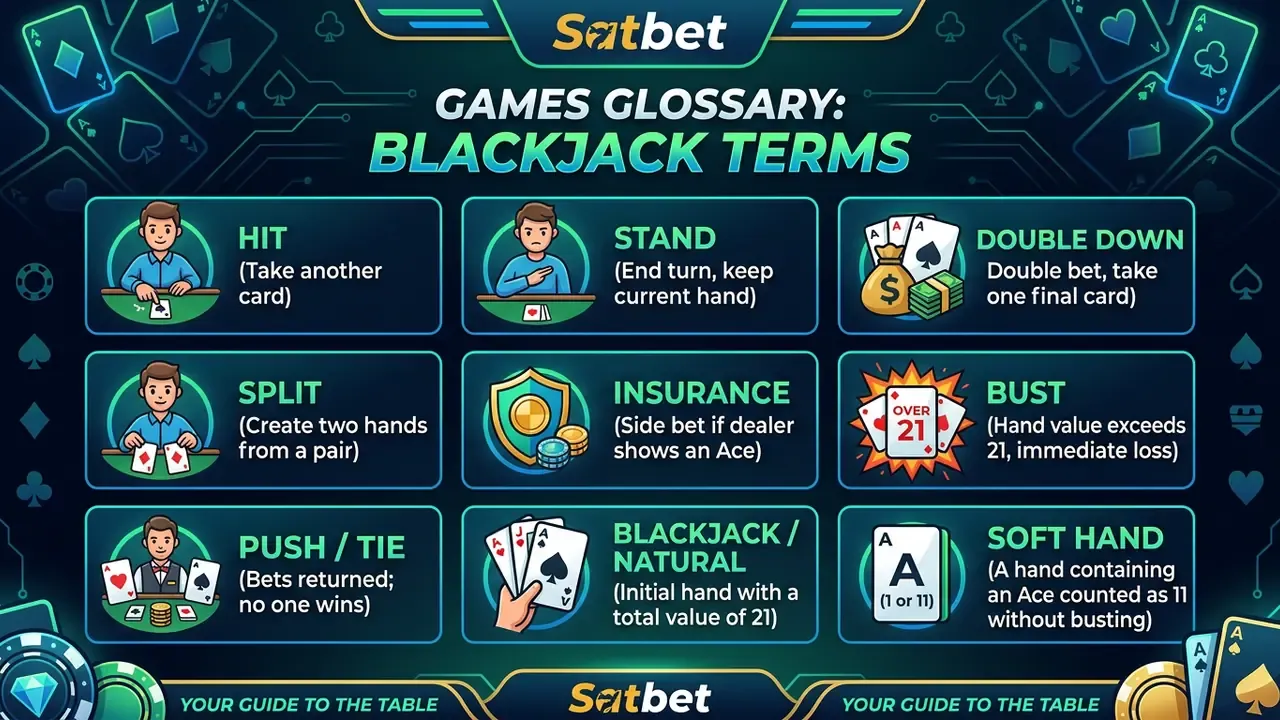
- Hand -The total collection of cards held by a player or the dealer during one round.
- Dealer -The casino representative who deals the cards and operates strictly under fixed table rules.
- Hit -The action of requesting an additional card to increase your numerical total.
- Stand -The choice to take no more cards, keeping your current hand total.
- Split -Dividing a pair of identical cards into two separate hands with an additional equal bet.
- Double -Doubling the initial bet after your first two cards, in exchange for exactly one more card.
- Insurance -A side bet placed when the dealer's visible card is an Ace, paying 2:1 if the dealer holds 21.
- Bust -A hand total exceeding 21, resulting in an automatic loss for that round.
- Push -A tie between the player and the dealer. The original bet is returned.
- Shoe -A device holding multiple decks of cards used by the dealer during the game.
How to Play Blackjack Online
To play blackjack online, you register at a secure digital casino, fund your account using local payment methods, select a digital table, and tap the interface to place wagers. Playing blackjack on the internet relies heavily on software integrity and your awareness of terms. Let me walk you through the steps.
From Choosing a Blackjack Casino to Placing Your First Bet
Here is the process broken down clearly:
- Choose a licensed casino. Look for active gaming licences (MGA, UKGC, or a recognised offshore authority). Verify that the platform publicly lists its licence number.
- Register and complete KYC. Upload government-issued ID (Aadhaar, PAN card, or passport) and proof of address. Clearing KYC before your first deposit prevents withdrawal blocks later.
- Fund your account. Check that local options such as INR, NetBanking, or UPI are supported. A smooth deposit means nothing if the withdrawal is blocked, so verify payout terms before you send money.
- Browse the blackjack lobby. Select a table that matches your bankroll. RNG tables often start at ₹10, while live tables may require ₹100 or more.
- Place your first bet and click "Deal." Adjust your virtual chips, confirm your wager, and the round begins.
"Players register an account, complete identity verification, then browse game categories including blackjack and live casino before placing their first real-money bet." - UK Gambling Commission, Exploring Consumer Journeys Playing Online Casino Games, 2022-2023.
For Indian users, payment friction matters heavily. Verify the terms carefully before your first deposit. Read them out loud if you have to.
What Makes Online Blackjack Convenient for New Players
Online blackjack is convenient for new players because it offers lower minimum bets, accessible strategy charts, and a self-paced environment. The digital format eliminates table pressure. You can evaluate your two cards without anyone rushing you.
"Online casinos allow players to play at their own pace, taking time to read on-screen instructions or consult strategy guides without social pressure." - UK Gambling Commission, Exploring Consumer Journeys Playing Online Casino Games, 2022-2023.
Digital platforms also provide numerous game options, meaning you can test lower limits before increasing your exposure. That flexibility alone makes online play a solid starting point for anyone still learning the rules of blackjack.
Legality and Safety for Indian Players
Before You Play: Always verify the legality of an online blackjack casino within your specific Indian state. Indian gambling law draws a distinction between "games of skill" and "games of chance," and this classification varies from state to state. States like Goa and Sikkim permit certain forms of gambling, while others restrict it heavily. Additionally, read the specific wagering requirements tied to any blackjack bonus before claiming it.
Safety checklist - red flags when choosing a casino:
- No visible gaming licence or regulation number on the website.
- Withdrawal policies hidden behind multiple links or vague language.
- No option to set deposit limits or self-exclusion tools.
- KYC verification demanded only after you attempt a withdrawal (legitimate casinos verify upfront).
- Bonuses with no clear wagering-requirement breakdown for table games.
If you or someone you know struggles with gambling, reach out to Indian helplines such as the Vandrevala Foundation (1860-2662-345) or iCall (9152987821).
Live Blackjack vs Standard Online Blackjack
Live blackjack streams a real human dealer to your screen, whereas standard online blackjack operates strictly through a verified Random Number Generator (RNG) software. Comparing the two formats helps manage your bankroll pacing and connectivity needs.
How Live Blackjack Changes the Player Experience
Live blackjack changes the player experience by adding a real dealer, actual physical cards, and a slower dealing pace that mimics a traditional casino table. Using high-definition streaming with multi-camera angles, players witness the dealer handling the shoe directly.
"Some online casino customers prefer live dealer games because they feel more like a real casino and seeing physical cards increases confidence in fairness." - UK Gambling Commission, Exploring Consumer Journeys Playing Online Casino Games, 2022-2023.
However, this real-time pacing demands quicker decisions from you. The typical decision window on live tables ranges from roughly 10 to 15 seconds, depending on the provider and table rules. That timer can feel surprisingly short when you are still cross-referencing a strategy chart.
When Standard Online Blackjack Is the Better Option
Standard online blackjack is the better option when you are learning the game, operating with a smaller budget, or dealing with unstable mobile internet connections. The games run instantly. You control when the cards are dealt. This zero-pressure environment is perfect for drilling a strategy chart until your decisions become automatic.
"Live and RNG blackjack can have identical RTPs and house edges if they implement the same rules and payouts." - UK Gambling Commission, RTP Technical Guidance, 2023.
The format difference is about experience, not mathematical advantage. Worth remembering.

| Feature | Live Blackjack | Standard Online Blackjack |
|---|---|---|
| Dealer Presence | Real human dealer on stream | Digital interface with RNG |
| Pace of Play | Controlled by dealer (30-60 s per round) | Instant, controlled by the player |
| Decision Timer | Strict limit (10-15 seconds) | No time pressure to make a decision |
| Starting Limits | Usually higher (e.g., ₹100-₹500 min) | Very low (often ₹10 min) |
| Social Interaction | Live chat available with dealer and other players | Solo play, no interaction |
Summary: Live blackjack offers a genuine table feel with real-time pressure, making it suitable for experienced players. Standard online blackjack provides lower bet minimums and unlimited time to think, making it a strong tool for beginners learning the game.
Blackjack Bets, Side Options and Common Table Choices
Blackjack bets revolve around your main wager against the dealer, while side options provide independent betting opportunities based on the probability of specific card combinations. Understanding table limits dictates your expected exposure per session.
Main Bets and How They Affect One Hand
The main bet is the foundational wager on your hand defeating the dealer, paying generally 1:1 on regular wins and 3:2 on a natural blackjack. Your initial bets shape your total risk. Choosing to double down multiplies this bet dramatically. Be extremely cautious of tables promoting a 6:5 payout on a blackjack.
"Rule variations that reduce the blackjack payout to 6:5 materially worsen the player's long-run expected return compared to the standard 3:2 payout." - Nevada Gaming Control Board, Game Mix Report; Georgia Institute of Technology, Probability Analysis of Blackjack.
A 6:5 table pays only 120% of your bet on a natural blackjack instead of 150%. That is a 20% reduction on your premium hand, and it steadily drains your bankroll over time. Protect your budget by sticking strictly to 3:2 payout tables. This single check can save you more money than any bonus ever will.
Side Options You May See at a Blackjack Table
Side options are additional wagers placed outside the main game, such as betting on your first two cards forming a pair or creating a poker sequence with the dealer's card. While options like "Perfect Pairs" or "21+3" seem exciting, their mathematical reality is weak.
"The theoretical RTP of side bets is usually lower than the main blackjack game, meaning the house edge on side options is materially higher." - UK Gambling Commission, RTP Technical Guidance, 2023.
Typical house-edge estimates for these side bets range from roughly 2% to 8% depending on the specific variant and rule set. That is substantially above the roughly 0.5% achievable on the main bet with basic strategy. Treat side bets as entertainment expenses, nothing more. They do not stabilise your core blackjack game.
Popular Blackjack Games and Formats to Explore
Popular blackjack games offer diverse rule modifiers, side actions, and varying payout structures that tweak classic strategies. Every casino blackjack menu holds specific options tailored for distinct bankroll setups and playing styles.
Classic Blackjack, Live Tables and Other Popular Options
Classic blackjack, live tables, and variations like Infinite Blackjack or Blackjack Switch manipulate the base game to build new formats. In Classic games, you face standard rules using 1 to 8 decks. In Live tables, social streaming meets real-time limits.
Infinite Blackjack allows thousands of players to bet on the exact same starting hand, solving the issue of full table capacities without losing the human dealer aspect. In Blackjack Switch, you receive two hands and may swap the second card of each, but a natural blackjack pays only 1:1 instead of 3:2 to offset the advantage. Each format has a trade-off. No version gives you something for nothing.

How to Choose the Best Blackjack Format for Your Style
To choose the best blackjack format for your style, map your bankroll limits and your desired playing speed before loading an app. If you use an intricate strategy card, standard classic formats provide the time necessary to cross-reference data. If you are entirely focused on an immersive casino-night vibe, live variants are worth checking out.
Skip aggressively modified games if you purely want basic odds. Lightning and Quantum formats offer random multipliers up to 1,000x, but the additional variance suits thrill-seekers rather than methodical strategists aiming for steady, low-edge play. Know yourself before you pick a table.
Can You Improve Your Chances of a Win in Blackjack
You can improve your chances of a win by strictly adhering to basic mathematical strategy rather than relying entirely on luck. A disciplined approach lowers the house edge. It will not guarantee wins, but it measurably reduces losses over time.
Reading Your First Two Cards and the Dealer Card
Reading your first two cards against the dealer card dictates your mathematical path to a possible payout. If your card total is weak and the dealer is showing a 5 or 6, standing forces the dealer to draw and potentially bust.
"When the dealer shows a 5 or 6, the probability of the dealer busting after drawing to 17 is relatively high, favoring conservative player standing." - Georgia Institute of Technology, Probability Analysis of Blackjack.
Memorise your combinations. Your two cards are the single biggest lever you control in any round of blackjack.

Simplified basic-strategy quick reference: player hand vs dealer up-card
| Your Hand | Dealer 2-6 | Dealer 7-A |
|---|---|---|
| 8 or less | Hit | Hit |
| 9 | Double (else Hit) | Hit |
| 10 | Double (else Hit) | Double vs 2-9, Hit vs 10/A |
| 11 | Double | Double vs 2-10, Hit vs A |
| 12 | Stand (Hit vs 2 or 3) | Hit |
| 13-16 | Stand | Hit |
| 17+ | Stand | Stand |
| A-A | Split | Split |
| 8-8 | Split | Split |
| 10-10 | Stand | Stand |
Tip: Save or screenshot this table and keep it open during your first sessions. Basic strategy reduces the house edge to roughly 0.5%, turning blackjack from a guessing game into a game of applied mathematics. This principle was first demonstrated by Edward O. Thorp in Beat the Dealer (1962).
Common Mistakes That Lead Players to Bust
"Players oscillate between conservative and risky behaviors based on recent wins and losses rather than probabilistic assessment of their current hand." - Delfabbro et al., Behavioral Tracking in Online Gambling, PubMed, 2023.

The most common mistakes that lead players to bust include misunderstanding soft totals, refusing to split 8s, and splitting 10s. Two 8s combine to a hard 16, statistically one of the worst hands possible in the game. Splitting them transforms a disadvantage into two workable 8s. A pair of 10s gives a 20. Abandoning a secured 20 for two splits weakens your total advantage and introduces unneeded risk.
Another frequent error is hitting a 12 against a dealer 2 instead of standing, which increases bust probability for minimal gain. I have seen this mistake more times than I can count, even among players who claim to know the rules.
"A curriculum-based deep Q-network improved win rate from 43.97% to 47.41% and reduced average bust rate from 32.9% to 28.0%." - Curriculum-Based Reinforcement Learning for Blackjack, 2025.
Machine-learning research confirms what the strategy chart shows: structured, consistent decision-making measurably reduces losses. The lesson is the same for human players. Follow the chart, suppress impulse, and your bust rate drops.
Fact Check:
- Myth:Blackjack is purely a game of luck.
- Fact:Edward Thorp's mathematical proofs in 1962 demonstrated that basic strategy, grounded in conditional probability, significantly reduces the house edge. Multiple academic replications, including Monte Carlo simulations and combinatorial analyses, have confirmed his findings.
- Myth:Live blackjack guarantees better RTP than online RNG tables.
- Fact:Licensed RNG blackjack tables hold the exact same mathematical probabilities as live dealer games provided the rules are identical (Technical Standards, UKGC, 2023).
- Myth:The insurance bet is a smart safety net.
- Fact:Insurance carries a negative expected value for the player under virtually all standard conditions (see the Insurance section above).
How Card Counting Works (and Its Limits Online)
Card counting is a strategy that tracks the ratio of high to low cards remaining in the shoe, giving the player information about when the deck favours them. It is not magic, and it is not illegal. But it is also not as useful online as many people assume. Here is the basic four-step Hi-Lo method:
- Assign every card a value. Cards 2-6 = +1. Cards 7-9 = 0. Cards 10, J, Q, K, A = -1.
- Maintain a running count. Start at zero and add or subtract as each card is revealed. A positive count means more low cards have been dealt, leaving the shoe rich in high cards, which favours the player.
- Calculate the true count. Divide the running count by the estimated number of decks remaining in the shoe. For example, a running count of +6 with 3 decks left = true count of +2.
- Adjust your bets. Increase your wager when the true count is high; reduce it when the count is negative or near zero.
Important caveat for online players: In RNG-based blackjack, the virtual deck is reshuffled after every hand, making card counting impossible. Card counting is only potentially applicable in live dealer games that use a deep shoe (6-8 decks) dealt to a significant penetration depth. Even then, most live-casino providers shuffle frequently or use continuous shuffling machines (CSMs) to neutralise counting. Card counting is not illegal, but casinos reserve the right to restrict players they suspect of counting.
Blackjack Bonuses: The Wagering-Requirement Trap
One of the biggest frustrations for Indian blackjack players is discovering that their casino bonus barely works on table games. Here is why that happens:
- Slot-friendly wagering. Most welcome bonuses require 30x to 40x wagering. Slots typically contribute 100% toward clearing the requirement. Blackjack, however, usually contributes only 5-10%.
- The maths. If you claim a ₹5,000 bonus with a 35x wagering requirement and blackjack counts at 10%, you would need to wager ₹5,000 x 35 / 0.10 = ₹17,50,000 on blackjack alone to unlock withdrawals. That is almost certainly more than your bankroll can handle.
- What to do instead. Read the bonus terms before claiming. Look specifically for "table-game bonus" or "live-casino bonus" promotions that credit blackjack at a higher percentage (ideally 50-100%). If none exist, skip the bonus and play with your own deposited funds. Your expected value is usually better without the strings attached.
This is one area where doing nothing is genuinely the smarter move. A bonus that you cannot clear is not a bonus at all.
Blackjack FAQ Before You Play
Before you handle real money options on mobile, finalise your understanding of the mechanics. These are the questions we see most often.
Is Free Blackjack Useful Before Playing for Real?
Free blackjack is highly useful before playing for real money because it permits aggressive strategy testing entirely free of financial stress.
"Demo play can help new players familiarize themselves with the interface and observe consequences of different decisions without financial consequences." - Armchair Arcade, Demo Mode vs Real Money Play, 2025.
Gambling behaviour analysts confirm that demo mode prevents immediate financial loss while cementing routine actions through repetition (Guidance on Responsible Gambling, UKGC, 2023). Use free mode to construct your limits, establish your walk-away point, and study the cards before engaging with a real bankroll. Treat casino play as entertainment with a firm stop line.
Tip: To find demo mode, look for buttons labelled "Practice," "Demo," or "Play for Fun" on the casino's blackjack lobby page. Many platforms let you play demo rounds before registering an account.
What Happens if Your Hand Goes Over 21?
If your hand exceeds 21 points, you "bust" and automatically lose the round, regardless of what the dealer holds. This rule is exactly why thoughtful decision-making on stiff hands of 12-16 is so critical. One impulsive hit can end the round instantly.
What Are the Card Values in Blackjack?
Cards 2 through 9 count at face value. Ten, Jack, Queen, and King are each worth 10 points. An Ace counts as 1 or 11, whichever benefits your hand most. This dual nature of the Ace is what creates "soft" hands and adds a layer of flexibility to your decisions.
Can You Count Cards in Online Blackjack?
In RNG-based blackjack the deck is reshuffled every hand, so card counting provides zero advantage. In live dealer games using a deep shoe, counting is theoretically possible but heavily mitigated by frequent shuffles and continuous shuffling machines. Do not build your strategy around it for online play.
What Is the Minimum Bet in Indian Rupees?
Minimums vary by platform. Standard RNG tables often start at ₹10-₹50. Live dealer tables typically begin at ₹100-₹500. Always check the table limits before sitting down, because some VIP tables can have minimums that would surprise you.
Is Online Blackjack Rigged?
Licensed platforms use RNG software certified to international standards (such as ISO/IEC 27001). Independent testing labs audit these systems regularly. Stick to casinos with a visible gaming licence, and outcomes are mathematically fair. If a platform hides its licence details, that itself is a red flag.
Should I Take the Insurance Bet?
In nearly all standard scenarios, no. The insurance bet carries a negative expected value because the probability of the dealer's hole card being a 10 is below the 33.3% threshold needed to make a 2:1 payout fair. Skip it.
Can I Play Online Blackjack for Free?
Yes. Most online casinos and game sites offer a free or demo version of blackjack that uses virtual chips. It is an excellent way to learn rules, practise basic strategy, and get comfortable with the interface before risking real money. No deposit, no pressure.
Last updated: July 2026. Information in this guide reflects rules and regulations current at the time of publication. Always verify the latest legal status of online gambling in your specific Indian state before depositing funds.